|
OPC PERFORMANCE |
nOAA GLERL Changes in Pelagic Food Web of southern Lake MI ProjectWe have a publication accepted on the OPC performance in J. Geophysical Res-Oceans -
We served as guest editors for a special section on the Optical ...halo-OPC ApplicationsCurrent OPC performance bottlenecks have caused engineers to make difficult
trade-offs between correction fidelity, model accuracy, and run-time. ...sPECopc Project Group OverviewStandard Performance Evaluation Corporation. Results. SPECopc. Download. Resources. SPECopc Project Group Overview ... 1995 - 2005 Standard Performance Evaluation Corporation. URL: spec/gpc/opc.static/overview.html ... [PDF] DCOM, OPC and Performance IssuesFile Format: PDF/Adobe AcrobatYour browser may not have a PDF reader available. Google recommends visiting our text version of this document.As you will see from the numbers below, OPC and DCOM performance are more ...
evaluate OPC performance. For purposes of this test we are doing synchronous ...oPC Performance Testing„Laurentide ControlsFile type:PDF - Download PDF ReaderWhitepaper. OPC Performance TestinggM Europe Gets TractionThe 240-horsepower Astra OPC performance car also has added spark to GM's image.
The launch of the new Astra Twin Top convertible -- a popular segment the ... |
|
Opc performance |
|
 |
|
|
Opc xml da |
|
 |
OPC OverviewThe OPC (OLE for Process Control) foundation has defined an OPC XML-DA standard that
... The rapid adoption of previous OPC standards makes the OPC-XML-DA ...OPC XML DA Server Gateway, Bridge to enlarge OPC COM based DA 1 2 ...OPC XML DA Server,Web Service, Gateway, Bridge, to enlarge OPC COM, DCOM based
DA 1 2 3 server with an OPC XML DA interface.OPC XML DA Server Side Gateway for access to OPC DA servers from OPC XML clients ... OPC XML Webservices - XML DA Gateways - XML-DA Server Side Gateway ... Unlike previous OPC data access specifications, the OPC XML-DA specification describes data exchange in an ... |
|
Opc performance |
|
 |
|
| > More informations about OPC ANTIOXIDANT |
|
|
| > More informations about
HISTORY OF OPC 3 |
in 1534, French explorer Jacques Cartier was leading an expedition up the St. Lawrence River. Trapped by bad weather, Cartier and his crew were forced to survive on a ration of salted meat and biscuits. Cartier's crew began to suffer from severe deficiency of vitamin C and showed symptoms of scurvy. Many crewmembers died before the surviving members encountered a friendly Native American who saved most of their lives. He told them to make a tea from the bark and needles of the pine tree to cure their malady. They complied and, as a result, Cartier and many crewmembers survived.some 400 years later, Professor Jacques Masquelier concluded that pine bark not only contained some vitamin C, but obviously was a good source of bioflavonoids, whose effects are similar to those of vitamin C. Further studies and research revealed that the pine bark contained an array of proanthocyanidins complexes. These compounds were also found in a variety of plants, including grape seeds, cranberries, peanut skin, lemon tree bark and citrus rinds. Masquelier termed the active ingredients of the pine bark "pycnogenols", which today are referred to in the scientific community as oligomeric proanthocyanidins, or OPCs.in 1534, French explorer Jacques Cartier was leading an expedition up the St. Lawrence River. Trapped by bad weather, Cartier and his crew were forced to survive on a ration of salted meat and biscuits. Cartier's crew began to suffer from severe deficiency of vitamin C and showed symptoms of scurvy. Many crewmembers died before the surviving members encountered a friendly Native American who saved most of their lives. He told them to make a tea from the bark and needles of the pine tree to cure their malady. They complied and, as a result, Cartier and many crewmembers survived.some 400 years later, Professor Jacques Masquelier concluded that pine bark not only contained some vitamin C, but obviously was a good source of bioflavonoids, whose effects are similar to those of vitamin C. Further studies and research revealed that the pine bark contained an array of proanthocyanidins complexes. These compounds were also found in a variety of plants, including grape seeds, cranberries, peanut skin, lemon tree bark and citrus rinds. Masquelier termed the active ingredients of the pine bark "pycnogenols", which today are referred to in the scientific community as oligomeric proanthocyanidins, or OPCs.in 1534, French explorer Jacques Cartier was leading an expedition up the St. Lawrence River. Trapped by bad weather, Cartier and his crew were forced to survive on a ration of salted meat and biscuits. Cartier's crew began to suffer from severe deficiency of vitamin C and showed symptoms of scurvy. Many crewmembers died before the surviving members encountered a friendly Native American who saved most of their lives. He told them to make a tea from the bark and needles of the pine tree to cure their malady. They complied and, as a result, Cartier and many crewmembers survived. |
| > More informations about OPC PERFORMANCE |
|
| > More informations about
OPCXTRA |
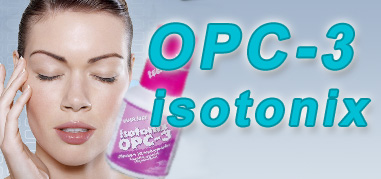
bioflavonoids are complex organic plant compounds found mostly in fruits and vegetables. They function as a cofactor or helper to the body's immune system to respond to inflammation, allergy and infection.oPCXtra is a super antioxidant drink mix made from a combination of six major sources of bioflavonoids. Four of the sources - Grape Seed Extract, Red Wine Extract, Pine Bark Extract and Green Tea Extract - supply a group of powerful antioxidant bioflavonoids called Oligomeric Proanthocyanidins (OPC).oPCXtra is totally bioavailable, water soluble and delivered in an isotonic solution, the way nature intended it to be. This product is delivered to the small intestines within five minutes, when taken as directed.oPC's are known to stabilize and protect collagen (a major protein in the body) from free radical damage and enzymatic digestion.bioflavonoids are complex organic plant compounds found mostly in fruits and vegetables. They function as a cofactor or helper to the body's immune system to respond to inflammation, allergy and infection. |
| > More informations about OPC PERFORMANCE |
|
|